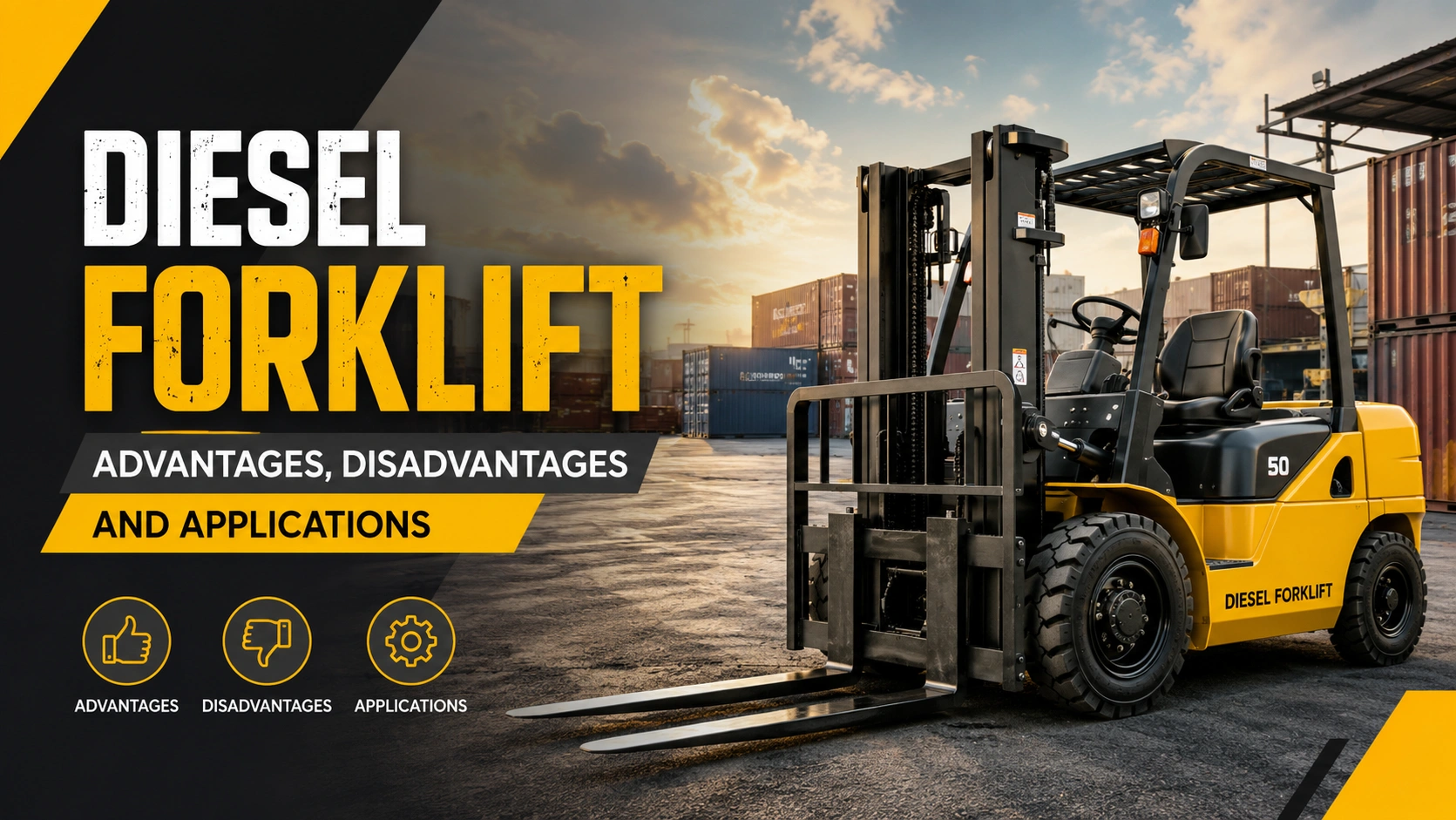
A diesel forklift is a great option for businesses that require reliable heavy material lifting and moving capabilities. Diesel forklift trucks are well suited for construction sites, manufacturing plants, warehouses, logistics centers and outdoor industrial areas due to their impressive capability of strong performance, durability and high lifting capacity.
But, not all applications are appropriate for a diesel forklift. Some factors that should be taken into consideration before investing in a machine include fuel consumption, maintenance, noise and emissions. Knowing the pros and cons of diesel forklifts can help to choose the most suitable material handling equipment for the business.
What is a Diesel Forklift?
A diesel forklift is an internal-combustion, material handling power machine fueled by a diesel motor. It is powered by the motor to move the forklift and to function the lifting system.
Businesses often find that forklift trucks with diesel power are ideal for transporting heavy loads on uneven terrain or for use in applications that require prolonged operations. They are powerful and durable, making them ideal for heavy-duty outdoor use.
Diesel Forklifts offer many benefits
1. Performance of high power and lifting.
The significant advantages of a diesel forklift are its capability to power. The forklift's strong torque from the diesel engine enables it to lift heavy loads and function well on gradients or difficult terrain.
Diesel forklifts are suitable for heavy industries and those types of industries that use heavy machinery, construction materials, steel products, timber or other bulky products, which always need the performance that can be supplied by a diesel forklift.
2. Excellent Outdoor Performance
Diesel powered forklifts work particularly well in outdoor material handling applications. They can be used on surfaces that are not ideal, such as construction sites, loading yards, and rough surfaces.
These qualities make them ideal for businesses that regularly move materials, as they're sturdy and can withstand rough surfaces and heavy loads.
3. Quick Refuelling
A diesel forklift can be refuelled relatively quickly, whereas an electric forklift will need to be charged and / or the battery replaced. This may be useful to companies with several shifts, where downtime of equipment is a critical concern.
Rapid fueling ensures uninterrupted material handling operations, especially in facilities with high volume.
4. Heavy-Duty Applications: Use for heavy-duty applications.
There are different types of diesel forklift trucks such as the one that can lift heavy loads. They boast a power-to-weight ratio, stability and a sturdiness that make them ideal for industries that demand continuous heavy-duty material handling.
5. Durable and Long-Lasting
If serviced and maintained properly, diesel forklifts can have a long life. They last long, and can be used in the toughest of places.
The durability of the diesel forklift can be beneficial for companies that have forklift operations which could require extended shifts or challenging circumstances.
The lack of Battery Charging Infrastructure.
There is no need for a specific battery charging station for a diesel forklift. This is useful for outdoor facilities or in places where there is limited electrical infrastructure.
As a result, businesses do not need to dedicate an area of the warehouse to charging stations for diesel equipment.
Disadvantages of a Diesel Forklift are evident
1. Higher Emissions
Diesel forklifts are not as well suited to poorly-ventilated indoor areas due to exhaust emissions. Emissions-control technologies may be used in modern machines, but still take workplace ventilation and regulations into account.
Electric forklifts might be the better choice for an indoor warehouse where air quality is an important issue.
2. Higher Noise Levels
The noise from diesel powered forklift trucks tends to be higher than the noise of electric forklifts. This can be one factor in increased noise levels in a high traffic environment.
When choosing a diesel forklift, companies should take into account the conditions found in their workplace as well as the comfort and safety of their operators.
3. Maintenance should be carried out regularly.
Diesel forklifts have engines, filters, lubricants and other mechanical parts that need regular maintenance. Oil change, fluid change, filter change and fluid inspection are significant maintenance components of performance.
Avoiding the planned maintenance can lead to inefficiency, unforeseen breakdowns and increased repair expenses.
4. Fuel Costs
Fuel is an ongoing operating expense. The specific use of a diesel forklift is dependent on various factors including load weight, hours of operation, terrain, driver behaviour and condition of the maintenance.
Before a forklift is purchased, businesses should estimate the amount of fuel they use and how much it costs in the total cost of ownership.
5. Less suitable for indoor operations
Due to exhaust emissions and engine noise, forklifts that run on diesel tend to be more suitable for outdoor or well-ventilated applications.
If food processing, pharmaceutical or other facilities have a strict air quality requirement, or if a business has an enclosed warehouse, an electric or other low-emission forklift could be the alternative.
Diesel Forklift vs Electric Forklift
The decision of which forklift type to select, diesel or electric, will depend primarily on the operating conditions and application.
If you are looking for a forklift for your heavy-duty outdoor applications, rough terrain, or lifting heavy loads, a diesel forklift is a good option to consider.
An electric forklift might be more appropriate for an indoor environment where businesses are looking to reduce direct emissions, quieter machines and access to charging stations.
The right selection should thus be considered on the basis of load capacity, working environment, shift duration, floor conditions, infrastructure and overall operating costs and not just the purchase price.
What are the typical applications for diesel powered forklift trucks?
Diesel forklift trucks are commonly used in:
- Construction sites
- Manufacturing facilities
- The steel and metal sectors.
- Timber and lumber yards,
- Logistics and distribution centres
- Outdoor warehouses
- Port and loading areas
- Agriculture and industrial yards such as a factory.
- Heavy engineering facilities
They have great utility when heavy loads must be carried in outdoor or rough terrain.
This article offers some guidance on selecting the right diesel forklift.
When it comes time to buy or rent a diesel forklift, there are a number of things that must be considered:
- Find the maximum weight to be lifted (Load Capacity).
- Lift Height: Select mast configuration to fit the storage and loading needs.
- Environment: Make sure the forklift is appropriate for the concrete floors or uneven ground inside and/or outside.
- Reliability of Maintenance Support: It is important to have access to reliable maintenance services and parts so that downtime is minimized.
- Fuel Requirements: Estimate the quantity of fuel needed for the job, based on the quantity of work and time of operation.
Conclusion
For companies that demand power, durability, and reliability in tough situations, a diesel forklift is still a viable material handling solution. It has excellent lifting capacity, rapid fueling and is well suited for outdoor use making it a valuable asset in the construction, manufacturing, logistics and heavy industrial sectors.
Meanwhile, the business should take emission, noise, fuel cost and periodic maintenance into account when selecting a diesel forklift truck. The ideal forklift would be one that is suitable for the company's load requirement, operating environment, and day-to-day workload.
Considering these elements can help businesses select a diesel forklift that offers reliable performance and facilitates safe and efficient material handling solutions.